
Questions? Call Us (855) 952-4581





Call Now For Guidance (855) 952-4581
Want To Know More About
Medicare? Start Here.
Want To Know More About
Medicare? Start Here.

Medicare 101
Online Workshop
Everything you need to know about Medicare, Your Coverage Options, and Enrollment Timelines in ONE session. Highly recommended! In less than an hour, you'll learn the ins and outs of Medicare.

Start Comparing Medicare Supplement and Advantage Plans Now
Get expert advice from a Bridge Care Licensed Advisor. Learn Medicare basics, Know your coverage options, and Get enrollment help... all tailored to your needs and budget
New to Medicare
What is Medicare?
Medicare is the federal health insurance program designed to give Americans access to affordable healthcare coverage. If you're turning 65, have a qualifying disability, or have been diagnosed with End-Stage Renal Disease, Medicare was built for you. Understanding how it works is the first step to making the right decisions about your health and your finances.

The basics.
Who Medicare is for
Medicare was signed into law in 1965 by President Lyndon B. Johnson, originally to ensure that Americans 65 and older could access the healthcare they needed. Today, more than 60 million people are covered by Medicare, and the program has expanded well beyond its original scope.
You may qualify for Medicare if you are 65 or older, under 65 with a qualifying disability, or diagnosed with End-Stage Renal Disease — permanent kidney failure requiring dialysis or a transplant. Most people enroll through the Social Security Administration, either automatically or by applying on their own.
It's important to know upfront: Medicare is not free. While many people qualify for premium-free Part A based on their work history, everyone pays a premium for Part B, and additional costs apply depending on the coverage you choose.
Know the limits.
What Medicare does not cover
One of the most common surprises people face after enrolling in Medicare is discovering what it doesn't pay for. Original Medicare is comprehensive for hospital and medical care, but several routine and long-term needs fall outside its coverage entirely. These include:
Long-term care (such as nursing home stays)
Routine dental care and dentures
Routine vision care
Hearing aids
Medical care received outside of the United States
Cosmetic or plastic surgery
Massage therapy
This is one reason many people choose to add a Medicare Advantage plan or a Medigap plan to their Original Medicare coverage. Some Advantage plans include dental, vision, and hearing benefits that Original Medicare does not provide.
Common misconceptions.
Medicare myths worth clearing up
There's a lot of misinformation out there about how Medicare works. Here are three of the most common myths — and the truth behind each one.
Myth: Medicare is free.
Medicare is not free. While most people qualify for premium-free Part A based on their work history, everyone pays a monthly premium for Part B. Depending on your income, that premium can be significantly higher. Additional costs — deductibles, copayments, and coinsurance — also apply throughout the year.
Myth: The government will tell you when to sign up.
Unless you are already receiving Social Security benefits at least four months before your 65th birthday, you will not be automatically enrolled. It is your responsibility to know your enrollment window and apply on time. Many people miss this and face consequences they didn't anticipate.
Myth: Missing your enrollment window is no big deal.
It can be a very big deal. If you fail to enroll during the correct period, you may face late-enrollment penalties that stay with you for as long as you are on Medicare — potentially for the rest of your life. Getting the timing right matters more than most people realize.
Understanding the structure.
The parts of Medicare — and what each one covers
Medicare is divided into four parts. Each part covers a different category of healthcare services, and together they form a complete picture of what the program offers. Here's what you need to know about each one.
Part A — Hospital insurance
Part A covers inpatient hospital care, skilled nursing facility stays, hospice care, and some home health services. Think of it as your room-and-board coverage when you're admitted to a hospital. Most people pay $0 for Part A at 65 because they — or their spouse — paid Medicare taxes for at least 10 years during their working years.
Part B — Medical insurance
Part B covers your outpatient services — doctor visits, lab work, preventive care, ambulance services, medical equipment, and outpatient surgeries. It also covers critical treatments like cancer therapy and kidney dialysis. Without Part B, you would be uninsured for most of the medical care you receive outside of a hospital stay. Part B has a monthly premium set by Social Security and adjusted each year based on your income.
Part C — Medicare Advantage
Medicare Advantage plans, also called Part C, are offered through private insurance companies approved by Medicare. When you enroll in a Part C plan, your coverage comes from the private plan rather than directly from the government — but you must still be enrolled in both Parts A and B to qualify. Advantage plans typically cover everything Original Medicare covers, plus they often include extra benefits like dental, vision, and hearing. Many plans have low or no monthly premiums, though your Part B premium still applies. Some plans include prescription drug coverage; others require you to add it separately. Keep in mind that Advantage plans usually have provider networks, meaning you may need referrals or be limited to certain doctors and hospitals.
Part D — Prescription drug coverage
Part D covers the cost of retail prescription drugs you pick up at a pharmacy or receive through mail order. It is offered through private insurance companies. Before 2006, Medicare offered no prescription drug coverage at all — Part D changed that. You can get Part D two ways: as a standalone drug plan added to Original Medicare, or included as part of a Medicare Advantage plan. Most states offer around 30 different Part D plans, each with varying premiums, formularies, and costs. Choosing the right plan depends on which medications you take, so it pays to compare your options carefully.
Medicare Supplement plans — Medigap
Original Medicare — Parts A and B — does not cover 100% of your healthcare costs. It typically leaves you responsible for deductibles, coinsurance, and copayments. Medicare Supplement plans, also known as Medigap, are private insurance policies designed to cover those leftover costs. If you're enrolled in Original Medicare and want more predictable out-of-pocket expenses, a Medigap plan can fill the gaps that Parts A and B leave behind. Note that Medigap plans cannot be combined with a Medicare Advantage plan — you choose one path or the other.
Taking action.
How to apply for Medicare
Applying for Medicare is simpler than most people expect — but the timing matters enormously. Missing your window can result in gaps in coverage and permanent late-enrollment penalties, so it's important to know exactly when and how to sign up.
When to apply
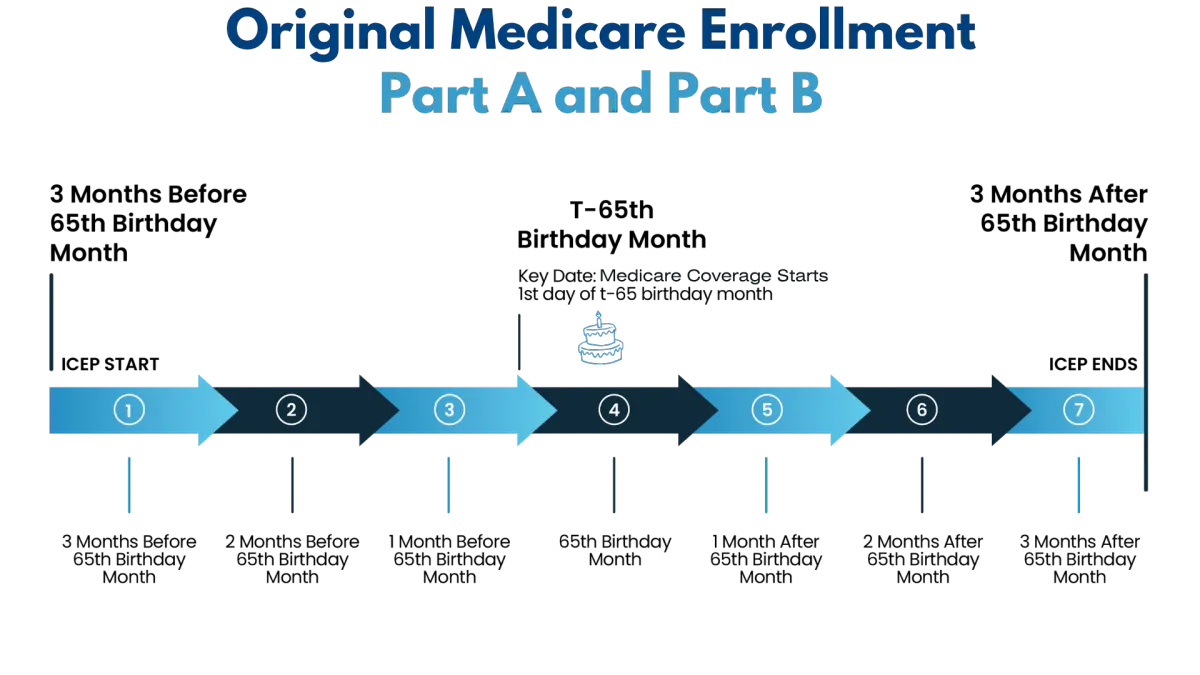
Your Initial Enrollment Period (IEP) is a seven-month window that begins three months before the month you turn 65, includes your birthday month, and extends three months after. This is your first and most important opportunity to enroll. If you sign up during the three months before your birthday month, your coverage can start as early as the first day of your birthday month. The longer you wait within the window, the later your coverage start date.
If you miss your Initial Enrollment Period and don't have qualifying coverage elsewhere — such as an employer plan — you'll have to wait for the General Enrollment Period, which runs from January 1 through March 31 each year. Coverage won't begin until July 1, and you may face a late-enrollment penalty that adds to your premium permanently.
Taking action.
How to apply for Medicare
Applying for Medicare is simpler than most people expect — but the timing matters enormously. Missing your window can result in gaps in coverage and permanent late-enrollment penalties, so it's important to know exactly when and how to sign up.
When to apply
Your Initial Enrollment Period (IEP) is a seven-month window that begins three months before the month you turn 65, includes your birthday month, and extends three months after. This is your first and most important opportunity to enroll. If you sign up during the three months before your birthday month, your coverage can start as early as the first day of your birthday month. The longer you wait within the window, the later your coverage start date.
If you miss your Initial Enrollment Period and don't have qualifying coverage elsewhere — such as an employer plan — you'll have to wait for the General Enrollment Period, which runs from January 1 through March 31 each year. Coverage won't begin until July 1, and you may face a late-enrollment penalty that adds to your premium permanently.
How to apply
You can apply for Medicare in three ways: online at SSA.gov, by calling the Social Security Administration at 1-800-772-1213, or by visiting your local Social Security office in person. The online application takes most people about 10 to 15 minutes to complete. You do not need to apply for Part A and Part B separately — one application covers both.
If you are already receiving Social Security retirement benefits when you turn 65, you will typically be enrolled in Parts A and B automatically and will receive your Medicare card in the mail. If you are not yet receiving Social Security benefits, you will need to apply on your own.
What you'll need to apply
Have the following ready when you apply: your Social Security number, your birth certificate or proof of age, proof of U.S. citizenship or legal residency, and your work history information. If you are applying based on a spouse's work record, you'll also need their Social Security number and work history.
Still working at 65?
Medicare and employer coverage — what to do
Turning 65 doesn't automatically mean you have to leave your employer's health plan behind. If you or your spouse is still working and covered through an employer, you have options — and the decisions you make here can have lasting consequences. Here's how to think through both situations.
If you're still working and have employer coverage
If you work for a company with 20 or more employees, your employer plan is considered your primary insurance and Medicare is secondary. In this case, you may be able to delay enrolling in Part B without facing a penalty, because your employer coverage qualifies as creditable coverage. Many people in this situation choose to enroll in Part A only — since it's typically free — and delay Part B until they retire or lose employer coverage.
However, if your employer has fewer than 20 employees, Medicare becomes your primary insurance and your employer plan is secondary. In that case, delaying enrollment could leave you with significant coverage gaps, and you should enroll in both Parts A and B during your Initial Enrollment Period.
Before making any decision, check with your HR department or benefits administrator to understand how your employer plan coordinates with Medicare. Do not assume — the rules vary by plan and employer size, and getting this wrong can be costly.
If you're retiring and losing employer coverage
When you retire or lose your employer health coverage, you qualify for a Special Enrollment Period (SEP). This gives you eight months from the date your employer coverage ends to enroll in Medicare without penalty. It's important to act within this window — once the eight months pass, you lose the special enrollment opportunity and may face late penalties.
Keep in mind that COBRA coverage does not count as creditable employer coverage for Medicare purposes. If you choose COBRA after leaving your job, you should still enroll in Medicare during your Special Enrollment Period — do not use COBRA as a reason to delay.
Retiring and enrolling in Medicare at the same time is an opportunity to reassess your coverage from the ground up. It's one of the best times to compare your plan options and make sure you're set up correctly for the years ahead.
Making the right choice.
How to choose the right Medicare plan
Once you understand the parts of Medicare, the next question is: which combination of coverage is actually right for you? There's no single answer that works for everyone. The right plan depends on your health, your finances, your doctors, and your preferences. Here are the key factors to work through.
Step 1
Start with Original Medicare or Medicare Advantage
Your first decision is whether to stay with Original Medicare (Parts A and B) and add supplemental coverage, or to replace it with a Medicare Advantage plan (Part C). Original Medicare gives you the broadest network — you can see any doctor or specialist in the country who accepts Medicare, without referrals. Medicare Advantage plans often have lower or no monthly premiums and may include extras like dental, vision, and hearing, but they typically limit you to a network of providers and may require referrals. Think about how often you travel, whether you have preferred doctors, and how much you value flexibility.
Step 2
Consider your prescription drug needs
If you take prescription medications, Part D coverage is essential. If you choose Original Medicare, you'll need to add a standalone Part D drug plan. If you choose a Medicare Advantage plan, check whether it includes drug coverage — many do, but not all. Compare plans based on your specific medications, not just the monthly premium. The plan with the lowest premium may not be the best value if your drugs have high copays under that plan's formulary.
Step 3
Decide whether you need a Medigap plan
If you choose Original Medicare, you'll be responsible for deductibles, coinsurance, and copayments that can add up quickly — especially if you use your coverage frequently. A Medigap plan can cover most or all of those costs, giving you more predictable expenses throughout the year. Medigap plans are standardized, meaning a Plan G from one carrier offers the same benefits as Plan G from another — the main difference is price. Shop around and compare premiums from multiple carriers.
Step 4
Factor in your budget
Look beyond the monthly premium. The total cost of your Medicare coverage includes premiums, deductibles, copays, coinsurance, and any out-of-pocket maximums. A plan with a $0 premium can still cost you significantly more out of pocket if you have frequent medical needs. Do the math based on how often you actually use healthcare services — not just what you hope will be true.
Step 5
Get personalized guidance
Medicare plan options vary by zip code, and the right choice depends on details that are specific to your situation. Working with a licensed Medicare specialist — at no cost to you — is one of the most effective ways to compare your options accurately and enroll with confidence. A good specialist will walk you through your choices without pressure and help you find the coverage that genuinely fits your needs.
Ready to learn more?
Get the full picture before you turn 65
Understanding Medicare is the foundation of a smart retirement plan. But knowing what the parts are is just the beginning — the real work is figuring out which combination of coverage is right for your health needs, your budget, and your lifestyle.
Our free Medicare 101 Workshop walks you through everything: how the parts work together, what mistakes to avoid, how to enroll without penalties, and how to choose the plan that fits you. It's designed specifically for people turning 65, and it's completely free to attend. Click below for the date and times of the next session.
Ready To Attend The
Medicare 101 Workshop?
Ready To Attend The
Medicare 101 Workshop?
Our free Medicare 101 Workshop walks you through everything!
Our free Medicare 101 Workshop walks you through everything!



Business Hours
Mon-Thurs: 8:30 AM – 6:30 PM
Fri: 8:30 AM – 4:30 PM
Company
Insurance
Helpful Resources
Get Connected With Us:
Email: [email protected]
Call Us! (855) 952-4581
Location: 120 19th Street North Ste. 231, Birmingham, AL 35203
This is a solicitation for insurance. Submitting information or calling numbers listed on this website will direct you to a licensed Agent/Broker.
Bridge Care Benefits LLC is an Insurance Benefits Company. Bridge Care Benefits LLC is not part of the Federal Government. We do not offer every plan available in your area. Any information we provide is limited to the plans we offer in your area. Call Medicare at 1-800-MEDICARE, or your local State Health Insurance Program (SHIP) to get information on all your options. You can also visit Medicare.gov. By filling out a form on this site or calling any number located on this site, you agree to allow a local-licensed sales representative to contact you regarding information related to Medicare health plans and health insurance plans, products, services and/or educational information related to health care.